
Betrayal within an intimate relationship is often described as heartbreak, disappointment or a loss of trust. For many people, however, prolonged deception can create something far more destabilising. It can affect their understanding of the relationship, their memories, their self-worth and their ability to feel safe.
This experience is often described as betrayal trauma. It may develop following the discovery or disclosure of affairs, hidden pornography use, compulsive sexual behaviour, secret communications, financial deception or another concealed reality within the relationship.
The injury is not always caused by one discovery alone. It can develop through a repeating cycle of suspicion, denial, partial disclosure, new discoveries and renewed uncertainty. Each additional piece of information may reopen the wound and reinforce the fear that the whole truth has still not been revealed.
For people affected by sexual or relational deception, specialist online therapy can provide a confidential space to understand what has happened and begin rebuilding emotional safety.
What Is Betrayal Trauma?
Betrayal trauma can occur when someone on whom you depend for attachment, security or emotional safety becomes the source of significant harm.
The distress is not simply about discovering an unwanted behaviour. It may also involve discovering that important parts of the relationship were concealed, minimised or deliberately distorted.
A betrayed partner may begin questioning:
- Which parts of the relationship were genuine?
- How long has the deception been happening?
- Was I manipulated when I raised concerns?
- What else remains hidden?
- Can I trust anything I have been told?
- Can I trust my own judgement?
When deception has been prolonged, the person may feel that the history of the relationship must be reconsidered. Memories that once felt secure can become uncertain. Events, conversations and explanations may be reinterpreted in light of what has been discovered.
The Hidden Cycle of Discovery and Deception
Betrayal trauma is rarely experienced as a simple, linear event. Many people become caught in a repeating cycle.
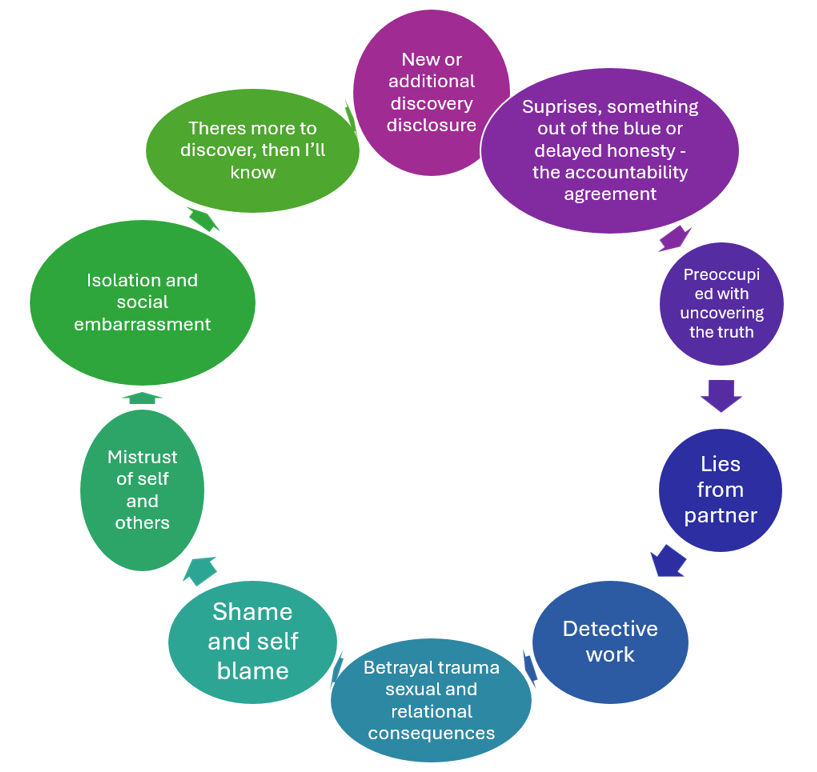
1. A New Discovery or Disclosure
The cycle may begin when hidden information comes to light. This could involve finding messages, photographs, online accounts, financial records or evidence of sexual or emotional behaviour outside the agreed boundaries of the relationship.
Sometimes the information is voluntarily disclosed. In other circumstances, it is uncovered after repeated denials or inconsistencies.
For the betrayed person, every new disclosure may feel like another shock. Even when the relationship is supposedly moving towards recovery, delayed honesty or partial information can return the person to the beginning of the trauma response.
2. Shock and Broken Accountability
Unexpected information often creates confusion and a feeling of being blindsided. The person may struggle to understand why the truth was withheld or why previous concerns were dismissed.
Common questions include:
- Why was I not told sooner?
- Why did I have to discover this myself?
- Why were my concerns denied?
- Is this the complete truth?
The injury is therefore not limited to the behaviour. The secrecy, denial, minimisation and manipulation surrounding the behaviour may create an additional layer of harm.
3. Preoccupation With Finding the Truth
After a significant breach of trust, the mind may become intensely focused on uncovering the full story.
This preoccupation is not simply curiosity. It can be the brain’s attempt to restore safety and certainty after discovering that the reality it accepted was incomplete.
The person may repeatedly ask questions, revisit conversations or try to establish an accurate timeline. They may believe that finding the final missing piece will allow them to feel safe again.
4. Detective Mode
Many betrayed partners enter what is sometimes called detective mode. They may:
- Review messages, accounts or records.
- Search for hidden applications or profiles.
- Look for inconsistencies in explanations.
- Monitor changes in behaviour.
- Ask the same questions in different ways.
- Try to verify dates, locations and timelines.
These behaviours are often attempts to protect against another devastating surprise. When information has been drip-fed, the desire to keep looking may be understandable.
However, living in investigative mode can also become exhausting. The person remains continually connected to the source of the trauma, unable to relax because their nervous system still expects another discovery.
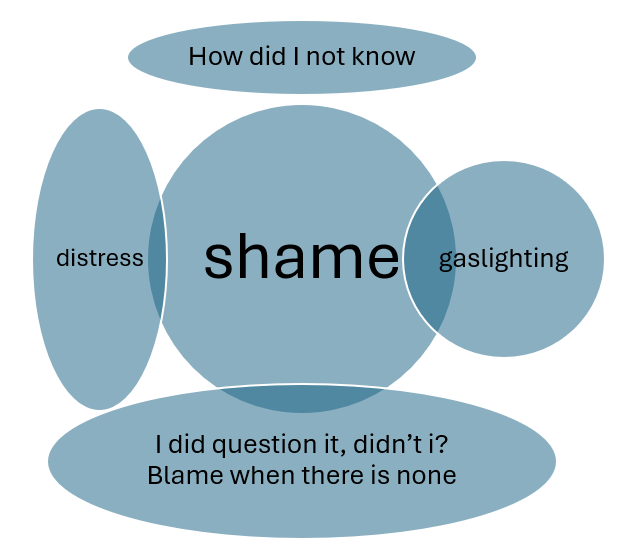
5. Shame and Self-Blame
One of the most painful stages is the movement from questioning the deception to questioning oneself.
The betrayed person may think:
- How did I not know?
- Why did I trust them?
- Should I have seen the warning signs?
- Was I not enough?
- Why did I stay?
This can turn responsibility in the wrong direction. Instead of remaining with the person who chose to deceive, blame is internalised by the person who was deceived.
Trusting someone is not evidence of foolishness. Healthy relationships normally depend on believing what a partner says. The capacity to trust, love and be vulnerable is not a personal failing.
6. Mistrust of Self and Others
Repeated deception can damage more than trust in a partner. It can also erode confidence in personal judgement.
People may begin wondering whether they can accurately assess situations, recognise danger or trust their own emotional responses.
This loss of self-trust can extend beyond the intimate relationship. It may affect friendships, work, family relationships and future decisions.
7. Isolation and Social Embarrassment
Betrayal may carry a profound sense of humiliation and loneliness. The person may withdraw because they fear judgement, unwanted advice or having to explain what has happened.
Some people also feel pressure to protect the reputation of the partner or maintain the appearance of a stable relationship. This can make it difficult to seek support precisely when support is most needed.
8. The Fear That There Is More to Discover
When previous information has been denied or released gradually, the mind may continue to expect another revelation.
The belief that there must be more to discover sends the person back into investigation, hypervigilance and renewed distress. The cycle then begins again.
“How Did I Not Know?”
After discovery, one of the most persistent questions is often not “Why did they do it?” but “How did I not know?”
This question can become central to the person’s experience of shame. Memories are repeatedly reviewed for missed clues. Past conversations are examined for hidden meanings. The person may assume that someone stronger, more intelligent or more observant would have discovered the truth sooner.
In reality, deception often works because the other person is actively trying to preserve a particular version of reality. Information may be concealed through lies, omissions, minimisation, plausible explanations or repeated reassurance.
The issue may not be that the betrayed person failed to notice. They may have noticed many times and been persuaded to distrust what they saw.
The Role of Gaslighting
Gaslighting can significantly deepen the effects of betrayal.
When concerns are repeatedly dismissed as irrational, exaggerated or imagined, the person may gradually lose confidence in their own perceptions.
They may hear statements such as:
- “You are overreacting.”
- “That never happened.”
- “You are too sensitive.”
- “You are imagining things.”
- “You are being paranoid.”
Over time, the person may stop trusting their observations. They may apologise for asking questions or suppress concerns to avoid conflict.
Later, when the truth emerges, another painful realisation can follow:
“I knew something was wrong, but I was persuaded not to trust myself.”
The damage caused by gaslighting is therefore not only confusion. It is the erosion of self-trust and the distortion of the person’s lived reality.
When Betrayal Becomes a Trauma Response
Following prolonged deception or a major discovery, people may experience symptoms commonly associated with trauma.
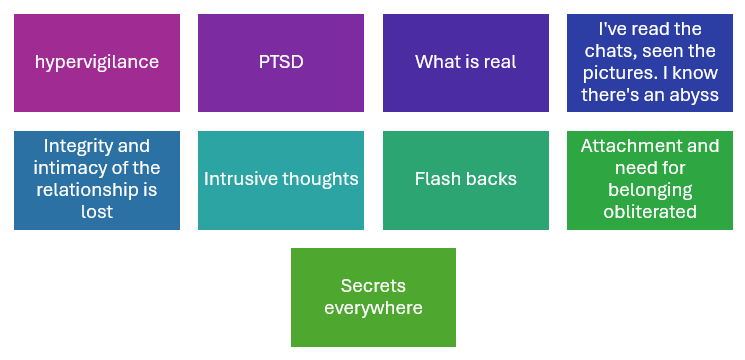
These can include:
- Hypervigilance.
- Intrusive thoughts.
- Difficulty sleeping.
- Emotional numbness.
- Panic or anxiety.
- Difficulty concentrating.
- Avoidance of reminders.
- Flashback-like emotional experiences.
- Anger, resentment or despair.
Not everyone who experiences betrayal will develop post-traumatic stress disorder. However, trauma-related symptoms may still have a substantial effect on everyday functioning and emotional wellbeing.
Hypervigilance
After betrayal, the nervous system may learn a painful lesson: what appeared safe was not safe.
The brain may therefore begin scanning continuously for further danger. The person might monitor changes in tone, behaviour, routines or communication. They may look for inconsistencies or anticipate another disclosure.
This response is not necessarily irrational paranoia. It may be the mind’s attempt to prevent another unexpected injury. Nevertheless, remaining on constant alert is physically and emotionally draining.
Intrusive Thoughts
Many people report being unable to stop thinking about what happened. Thoughts and images may arrive during work, while driving, in conversation or during the night.
The mind may continue returning to unanswered questions because the experience has not yet been fully processed or integrated.
Intrusive thoughts are not evidence of weakness or a refusal to move on. They can be part of the mind’s effort to understand a reality that has suddenly changed.
Emotional Flashbacks and Triggers
A song, date, location, photograph or notification sound can reconnect someone with the shock and distress of discovery.
The person may know intellectually that the event is not happening again, while their nervous system responds as if the danger is present.
These triggers can make everyday environments feel unpredictable and unsafe.
The Loss of Relational Integrity
Intimacy depends on authenticity. Meaningful connection requires enough truth for both people to make informed choices about the relationship.
When important information has been deliberately concealed, the betrayed person may realise that they were participating in the relationship without access to its full reality.
The loss may include:
- The future they believed they were building.
- The safety they thought existed.
- The mutual connection they believed they shared.
- The identity of the person they thought they knew.
- The integrity of their shared history.
This can create a form of grief. The person may be mourning not only what happened, but what the relationship had represented.
Attachment: Wanting Closeness and Distance at the Same Time
Betrayal can create a painful conflict within the attachment system.
The person who once provided comfort and belonging may now be associated with danger. As a result, the betrayed partner may simultaneously:
- Long for closeness and fear closeness.
- Want answers and want distance.
- Seek reassurance and distrust reassurance.
- Want the relationship to survive and want to escape it.
This apparent contradiction can feel confusing, but it reflects the depth of the relational injury. The source of attachment and the source of pain have become the same person.
Breaking the Cycle
Recovery does not come solely from discovering every hidden detail. Accurate information may be important, particularly where disclosure has been partial or misleading, but long-term healing also requires the rebuilding of safety.
Honesty Without Further Harm
Consistent truthfulness is essential. Continuing secrets and partial disclosures can prolong the trauma cycle.
However, disclosure should not become an uncontrolled transfer of guilt in which the person who acted out shares excessive detail simply to relieve their own discomfort. The process needs care, responsibility and an understanding of the impact on the injured partner.
Accountability and Humility
The person responsible for the deception must be able to take responsibility without defensiveness, minimisation or blame shifting.
Meaningful recovery requires humility: the willingness to listen, learn, tolerate difficult feedback and understand the consequences of one’s behaviour.
Emotional Validation
The injured partner’s distress needs to be acknowledged rather than dismissed. Anger, fear, confusion and repeated questions may all be responses to profound relational injury.
Listening does not mean agreeing with every conclusion. It means recognising that the person did not choose to be placed in this situation.
Rebuilding Self-Trust
Healing involves more than deciding whether another person can be trusted. It also involves reconnecting with personal intuition, judgement and inner strength.
This may include:
- Recognising when previous concerns were valid.
- Separating responsibility from self-blame.
- Challenging shame-based beliefs.
- Learning to identify personal boundaries.
- Taking time before making major decisions.
- Seeking support from trusted people or a qualified therapist.
Professional Support for Betrayal Trauma
Betrayal trauma can affect emotional health, physical wellbeing, sexuality, decision-making and the ability to feel safe within relationships.
Specialist therapy can help you understand the impact of discovery, process intrusive thoughts and emotional triggers, rebuild self-trust and consider what you need moving forward.
Support may involve individual work, work with the partner who has been affected, or carefully structured relationship work where honesty, accountability and sufficient stability are present.
You can learn more about:
- Support for partners affected by sexual addiction
- Sex addiction and compulsive sexual behaviour
- Relationship counselling
- Online therapy throughout the UK
Frequently Asked Questions
Is betrayal trauma a recognised emotional response?
Betrayal can create symptoms associated with trauma, including hypervigilance, intrusive thoughts, sleep disturbance, emotional numbness and difficulty concentrating. Not everyone develops a formal trauma diagnosis, but the emotional and physiological effects can still be significant.
Why do I keep searching for more information?
The search for information can be an attempt to restore safety after discovering that important facts were concealed. When disclosure has been incomplete, the mind may remain focused on identifying further risks or inconsistencies.
Why do I blame myself for being deceived?
Self-blame can create an illusion of control. It may feel easier to believe that you should have known than to accept that someone you trusted deliberately concealed important information. Responsibility for deception belongs to the person who chose to deceive.
Can trust be rebuilt after betrayal?
Trust may sometimes be rebuilt, but it cannot be restored through promises alone. It requires honesty, accountability, transparency, empathy and consistent evidence of change over time. Reconciliation is not the only valid outcome, and the injured partner has the right to decide what is appropriate for them.
Can betrayal trauma therapy be provided online?
Yes. Secure online therapy can provide confidential specialist support for people throughout the UK. It may be particularly useful when distress, work commitments, location or privacy make attending in person difficult.
Support After Betrayal and Discovery
You do not have to make immediate decisions about the future of your relationship. Therapy can provide space to understand what has happened, separate responsibility from self-blame and identify what you need to feel emotionally safe.
Learn more about confidential online therapy with IB Counselling.
This article forms Part One of our two-part guide. Continue to Healing After Betrayal Trauma: Rebuilding Intimacy, Safety and Trust.
Source theme: Aghamiri et al. (2024), comprehensive research into the lived experiences and wellbeing of partners following discovery or disclosure of compulsive sexual behaviours or sexual addiction.